How to Reapply Sunscreen Over Makeup
The honest version: nothing you apply over makeup matches a fresh layer. Here is what works anyway, ranked, and the days reapplying matters most.
How this is funded: we earn a commission if you buy through our links, at no extra cost to you. It never changes which product we recommend, and we’ll tell you when we’d skip one. Full disclosure.
Why this is genuinely hard
The number on a sunscreen bottle is not a property of the formula alone. It is the result of testing at a defined application amount, and the FDA’s consumer guidance on sunscreen makes a point of application quantity for exactly that reason. Apply half as much and you do not get half the SPF — you get considerably less than half.
That is the whole problem with reapplying over makeup. The physical act of pressing product onto a finished face limits you to a thin layer, and the thing underneath limits how much you can move it around without wrecking it. So every method on this page is a compromise, and it is worth saying so plainly rather than pretending a powder delivers SPF 30.
The good news is that the morning application does most of the work. If you apply properly before makeup — the full quarter-teaspoon for a face, as how much sunscreen to applysets out — then a partial top-up at lunchtime is maintenance rather than rescue.
The three approaches, ranked
1. A tinted mineral lotion, patted on
This is the best of the realistic options and the method in the steps above. Tint is what makes it work: because a visible film over foundation reads as coverage rather than as a cast, you can use a genuinely useful amount instead of the invisible smear you would get away with from a clear formula. Mineral filters also sit on the surface, which is the behavior you want from a top layer — see mineral versus chemical for the mechanism.
Technique matters more here than in any other sunscreen application. Blot first, pat rather than rub, and do two passes with a pause between them. A damp makeup sponge is the single most useful tool, because it presses product down instead of dragging it sideways.
2. Remove and redo, on the days it counts
Unglamorous and the only method that actually restores full protection. If you are going to be outdoors for hours — a long lunch, a match, a wedding, a beach — take the makeup off the exposed areas with a micellar pad, reapply sunscreen properly, and redo the makeup if you want to. Prioritizing the makeup over the sunscreen on that specific kind of day is the trade people regret.
3. Powder or mist, understood as a top-up
A mineral sunscreen powder is convenient, non-disruptive and the format most people will genuinely use at 2pm, and on a mostly-indoor day it is a reasonable addition. It is not your sun protection, for the application-amount reason above. The same goes for SPF setting sprays, which are useful for the ears, hairline and back of the neck — the places everyone misses — and insufficient as the main event.
When you actually need to reapply
The two-hour rule is about exposure, not about the clock, and treating it as a clock rule is why people either ignore it or exhaust themselves following it. Reapply when:
- You have been outdoors for two hours or more.Commuting, walking at lunch, sitting outside a cafe — it adds up.
- You have been swimming, sweating or towel-drying. Water resistance is a time-limited claim, as choosing a sunscreen explains, and towelling removes product mechanically.
- You are sitting beside a window for long stretches. Ordinary glass blocks most UVB but far less UVA.
And the honest converse: a day spent entirely indoors away from windows does not use up your morning application. Spending the energy on a thorough first application and on shade, hats and sleeves beats a daily ritual of patting powder over a desk tan you were never getting.
What to look for in a reapplication sunscreen
A tint, ideally with a shade range. One universal beige works on a narrow slice of skin tones; a real range means the layer disappears into your makeup instead of sitting on it. Mineral filters, because they behave better as a top layer. A lotion rather than a thin fluid— more viscosity means less sliding of what is underneath. Fragrance-free, since this is going on mid-day over whatever else is already there. A size you will carry, because the sunscreen in your desk drawer is the one that gets reapplied.
Two tinted minerals that layer over makeup
Both are 100% mineral and fragrance-free, which is what makes them workable as a top layer. We own no units and test nothing; picks come from the published formulation, and prices are checked daily.
Best shade range
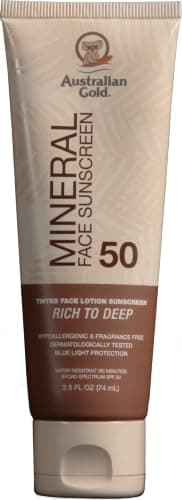
Australian Gold Mineral SPF 50 Tinted Face
For medium-to-deep skin, where a single universal tint never matches: 4% zinc oxide and 4% titanium dioxide at SPF 50, in three shades up to Rich to Deep.
$18.99 · View on AmazonPrice as of October 5, 2026. #ad How we’re funded
Best finish, fair to medium skin
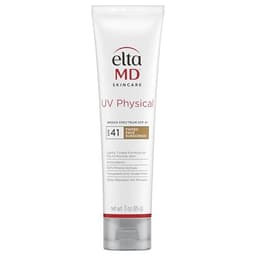
EltaMD UV Physical Tinted SPF 41
For fair-to-medium skin that wants the most cosmetically elegant option: 9% zinc oxide and 7% titanium dioxide with a universal iron-oxide tint, at a prestige price.
$48.00 · View on AmazonPrice as of October 5, 2026. #ad How we’re funded
We have deliberately not picked a powder or a stick. Both are genuinely useful formats for this job, and we do not currently have one in our registry whose filter panel we have read and verified — so rather than recommend a product we have not checked, we are saying so. If you already own a mineral powder you like, use it as the top-up described above.
The part nobody wants to hear
If reapplication is a constant battle with your makeup, the fix might be upstream. A sunscreen you apply generously at 8am, under lighter makeup, in combination with a hat and the shady side of the street, protects you better than an elaborate patting ritual over full coverage. Our how to apply sunscreen guide covers the morning half, and the sunscreen picks cover finding one you do not mind wearing enough of.
General guidance, not medical advice. Barrier & Balm is written by a skincare enthusiast, not a dermatologist. For a diagnosis, a reaction, or a prescription active like tretinoin, see a qualified professional. Introduce any new active slowly and patch-test first.
Frequently asked questions
Can you reapply sunscreen over makeup?
You can add a meaningful amount of protection over makeup, but not the same amount as a fresh application. The practical method is to blot away oil, then press a tinted mineral sunscreen over the top with a damp sponge or fingertips in two passes rather than rubbing it in. Accept that it is a partial top-up: the SPF on a label is established at an application amount nobody reaches when patting product over foundation.
Does sunscreen powder actually work?
As a top-up on a day that is mostly indoors, it is better than nothing and it is the format people will actually use. As your sun protection, no. The labeled SPF of any sunscreen is determined at a defined amount of product per area of skin, and a dusting of powder does not come close to that, which is why a powder should never be the only thing between you and several hours outdoors.
How often do you need to reapply sunscreen?
Every two hours of sun exposure, and immediately after swimming, towel drying or heavy sweating. The two-hour rule is about exposure rather than about the clock: a day spent at a desk away from windows does not consume your morning application the way an afternoon outdoors does. Be strict on the days it matters and relaxed on the days it does not, rather than ignoring the rule entirely because it is inconvenient.
Is a sunscreen setting spray enough?
Treat it as a top-up, for the same reason as powder: you cannot reach a protective amount with a mist, and most people spray far less than they imagine. A spray is useful for the back of the neck, the ears and a part line, which are the places people reliably miss. It is not a substitute for applying a lotion properly before you go out.
Should I use a mineral or chemical sunscreen for reapplying over makeup?
Mineral, usually. Mineral filters sit on the surface, which is exactly what you want from a layer going on top of makeup, and a tinted mineral blends into foundation instead of greying it out. Chemical sunscreens are often more liquid and more likely to dissolve and streak what is underneath when you try to work them in.
Can I just use a foundation with SPF instead?
It helps, but it rarely does the whole job. The SPF claim on a foundation is established at the same application amount as any other sunscreen, and nobody applies foundation that thickly — so in practice you get a fraction of the stated number. Use a proper sunscreen underneath and treat the foundation's SPF as a bonus rather than as the protection.
Sources
- U.S. FDA — Sunscreen: How to Help Protect Your Skin from the Sun — FDA on SPF numbers, broad-spectrum and application amount (accessed July 17, 2026)
- American Academy of Dermatology — How to decode a sunscreen label — AAD on SPF, broad spectrum and water resistance claims (accessed July 17, 2026)
- American Academy of Dermatology — Skin care basics — AAD consumer guidance on cleansing, moisturizing and sun protection (accessed July 17, 2026)
Keep reading
How to apply sunscreen
The first application, which matters far more than any reapplication method.
Read the guideHow much sunscreen to apply
The quarter-teaspoon problem, and why thin layers undo the number on the bottle.
Read the guideBest mineral sunscreen
The tinted mineral options that make reapplying over makeup possible at all.
See the picksBest sunscreen for deeper skin tones
Where tint stops being cosmetic and starts being the thing that makes SPF wearable.
See the picksMineral vs chemical sunscreen
Why mineral filters are the practical choice for a layer that goes on top.
Read the comparisonSPF vs moisturizer with SPF
Why a two-in-one rarely gets applied at a protective amount.
Read the comparisonWhy is my skincare pilling?
The sliding and rolling that happens when you layer onto a damp or oily face.
Read the guideBest sunscreen for your face
The morning application that determines most of your day's protection.
See the picks