Zinc Oxide vs Titanium Dioxide
The only two sunscreen filters the FDA has proposed as safe and effective — and they are not interchangeable. How each one covers the UV spectrum, why most bottles contain both, and which to buy.
How this is funded: we earn a commission if you buy through our links, at no extra cost to you. It never changes which product we recommend, and we’ll tell you when we’d skip one. Full disclosure.
A pick for each filter
One tinted mineral led by zinc oxide and one that is titanium dioxide alone, so you can see the trade in two real products. Both state their percentages on the FDA drug label, which sunscreens must and cosmetics do not. We have not tested either — the picks come from the published label facts, and prices are checked daily.
Zinc-led pick
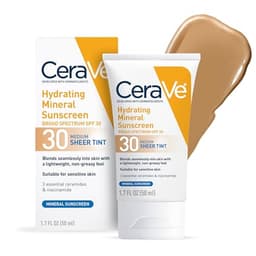
CeraVe Hydrating Mineral Sunscreen Sheer Tint SPF 30
A stated 10% zinc oxide with 5.5% titanium dioxide, over a base of three ceramides, niacinamide and hyaluronic acid. The broadest single-filter coverage here, at the lowest price.
Titanium-only pick
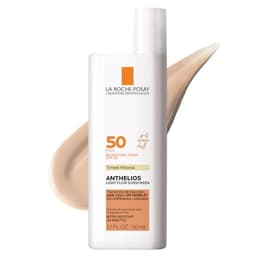
La Roche-Posay Anthelios 50 Tinted Mineral Sunscreen
A stated 11% titanium dioxide and no zinc at all — the option if zinc oxide is what your skin reacts to, and the silkiest finish of the minerals we cover.
If you have decided on a mineral sunscreen, you have decided on one or both of exactly two ingredients. Zinc oxide and titanium dioxide are the only two active sunscreen ingredients the FDA has proposed as generally recognized as safe and effective, at concentrations up to 25%. For twelve other filters, the agency has said the public record does not yet hold enough data to make that call. That single regulatory fact is why the mineral aisle exists in the shape it does.
What the label will not tell you is that the two minerals are not doing the same job. Most buyers treat them as one category — “physical” filters, interchangeable — and they are not.
The one real difference: which part of the spectrum each covers
UV that reaches your skin splits into UVB (roughly 290–320 nm, the burning wavelengths) and UVA (320–400 nm, which penetrates deeper and drives most photoaging). UVA itself splits again into the shorter UVA2 and the longer UVA1, and UVA1 is the stubborn end — it is what passes through window glass and what a lot of sunscreens historically under-covered.
The published review of the two inorganic filters puts the difference plainly: zinc oxide has a broad UVA–UVB absorption curve, while titanium dioxide provides better UVB protection. In practice that means zinc is the more even of the two across the whole range, and titanium is the stronger specialist at the burning end. Neither is a UVA1 champion in the way a modern European filter is, but between the two, zinc holds up better the further into UVA you go.
It is also worth retiring the physics most of us were taught. Mineral sunscreens are routinely described as “reflecting” or “scattering” UV like tiny mirrors. The literature on both filters finds they protect primarily by absorbing UV, the same basic mechanism as a chemical filter — they simply happen to be opaque, which is where the white cast comes from and why the mirror story stuck.
Zinc oxide vs titanium dioxide at a glance
| Zinc oxide | Titanium dioxide | |
|---|---|---|
| Spectrum | Broad, even UVA–UVB absorption curve | Better UVB protection; weaker at the long UVA end |
| As the only filter | Workable — zinc-only sunscreens exist and pass broad spectrum | Possible, and sold — but it is leaning on its weaker suit for UVA |
| Typical stated strength | 4–10% in the tinted face sunscreens we cover; up to 25% is permitted | 4–11% in the same products |
| White cast | Yes — driven more by total mineral load than by which mineral | Yes, same caveat |
| FDA status | Proposed GRASE up to 25% | Proposed GRASE up to 25% |
| Also used as | A skin protectant in diaper and barrier creams | A white pigment — it is a colorant first, historically |
Why almost every bottle contains both
Pull the drug facts panel on the mineral sunscreens we cover and the pattern is immediate. The pairing is the norm, not the exception:
- EltaMD UV Physical Tinted SPF 41 — 9% zinc oxide + 7% titanium dioxide
- Blue Lizard Sensitive Mineral SPF 50 — 10% zinc oxide + 8% titanium dioxide
- CeraVe Hydrating Mineral Sheer Tint SPF 30 — 10% zinc oxide + 5.5% titanium dioxide
- Australian Gold Tinted Mineral SPF 50 — 4% zinc oxide + 4% titanium dioxide
- La Roche-Posay Anthelios 50 Tinted Mineral — 11% titanium dioxide, and no zinc
Four out of five pair them, and the reason is not caution. Combining the filters lets a formulator reach a given SPF with a lower total mineral percentage, and total mineral percentage is what you see in the mirror. The La Roche-Posay outlier is instructive in the other direction: 11% titanium is the highest single-filter load of the five, which is exactly what a titanium-only formula has to do to carry SPF 50.
This is also why the SPF number and the filter split are not independent. A low combined load like the Australian Gold 4%/4% is the lightest-wearing of the group, and the one where under-applying costs you the most — so it is the one to be most diligent about reapplying.
So which should you buy?
Buy a zinc-led formula if…
You want the best single-filter coverage, you are buying sunscreen mainly to slow photoaging rather than to avoid burning, or your skin is rosacea-prone, post-procedure or otherwise in a state where zinc’s long record as a skin protectant matters to you. Zinc-led is the default recommendation for a reason. Our rosacea routine and sensitive-skin routine both lean on zinc-containing mineral SPF for the same reason.
Buy a titanium-only formula if…
Zinc oxide is what has not agreed with your skin. This is a real and under-discussed case: people who conclude “mineral sunscreen doesn’t work for me” have often only tried zinc-heavy ones. A titanium-only broad-spectrum formula is a genuine alternative, and because titanium is the pigment-grade mineral, these tend to have the most refined finish. Accept the trade: you are choosing finish and tolerance over the broader UVA curve.
Ignore the split entirely if…
Both bottles in front of you say broad spectrum and SPF 30 or higher. At that point the filter split is the least important variable on the label. Broad spectrum is a tested claim with a defined threshold, not a marketing word, and a sunscreen that carries it has already cleared the bar. What decides whether you are actually protected is how much you put on and whether you reapply — and that is a question about how much you apply and whether you like wearing it, not about chemistry.
What the percentages do and do not tell you
Sunscreens are regulated as over-the-counter drugs in the US, which is why every bottle states its active percentages to a decimal while the niacinamide serum next to it on the shelf can keep its concentration a secret. Make use of that: the drug facts panel is the most honest label in skincare, and it is the one place our usual complaint about undisclosed strengths does not apply.
What the percentages do notgive you is a protection ranking. A 20% mineral load does not deliver twice the protection of 10% — SPF is tested on the finished formula, and dispersion, particle size and the base all change the result. Two sunscreens with identical percentages can test to different SPFs. Read the percentages to understand the kind of coverage and the likely cast; read the SPF and broad-spectrum claim for the protection itself.
The honest bottom line
Zinc oxide is the better filter if you are forced to pick one, and most of the time you are not being asked to. The real decision in the sunscreen aisle is not zinc versus titanium — it is tinted versus untinted, lotion versus fluid, and whether the bottle in your bag is one you will reach for at lunchtime. Pick the broad-spectrum SPF 30+ you will wear generously, and let the filter split be the tiebreaker it actually is.
General guidance, not medical advice. Barrier & Balm is written by a skincare enthusiast, not a dermatologist. For a diagnosis, a reaction, or a prescription active like tretinoin, see a qualified professional. Introduce any new active slowly and patch-test first.
Frequently asked questions
Is zinc oxide or titanium dioxide better for sensitive skin?
Both are reasonable, and both are far gentler on reactive skin than the chemical filters that sting eyes. Zinc oxide has the longer history as a skin protectant and is the usual recommendation for rosacea-prone and post-procedure skin. Titanium dioxide is the better answer for the minority of people who find zinc itself drying or irritating. If one mineral sunscreen has not agreed with you, check which filter it used before you give up on minerals entirely — switching the mineral is a real option.
Why do most mineral sunscreens contain both?
Because they cover different parts of the spectrum. Titanium dioxide is the stronger UVB filter and zinc oxide gives the more even UVA coverage, so combining them is the simplest way to hit a broad-spectrum claim without a chemical filter. It also helps cosmetically: blending the two lets a formulator hit a given SPF with a lower total mineral load, which means less white cast than either filter would leave on its own at the same SPF.
Which leaves more white cast, zinc oxide or titanium dioxide?
Both do, and the honest driver is the total percentage of mineral in the bottle rather than which mineral it is. A sunscreen with 18% combined filters will whiten more than one with 8%, regardless of the split. What actually fixes cast is a tint: iron oxides cancel the whitening and add a little visible-light protection. If a plain mineral sunscreen leaves you ashy, a tinted one in the right shade is the fix.
Are zinc oxide and titanium dioxide FDA approved?
They are the two active sunscreen ingredients the FDA has proposed as generally recognized as safe and effective, at concentrations up to 25%. For twelve other filters — including avobenzone, oxybenzone, homosalate, octinoxate, octisalate and octocrylene — the FDA has said the public record does not yet contain enough data for a positive determination. That is a data gap, not a finding of harm: a chemical sunscreen you will reapply still beats a mineral one you leave in the drawer.
Is nano zinc oxide or nano titanium dioxide safe?
The particle size is what makes a modern mineral sunscreen wearable rather than chalky, and the FDA's proposed safe-and-effective status covers these filters as used in sunscreens today, micronized particles included. The published reviews of the two filters find they work primarily by absorbing UV rather than simply reflecting it, and that they do not meaningfully penetrate intact skin. If you would rather avoid very fine particles anyway, choose a lotion over a loose powder or an aerosol — the inhalation question, not the skin one, is the sensible reason to care.
Can I use a titanium dioxide sunscreen as my only SPF?
Yes, if the label says broad spectrum. A broad-spectrum claim is a tested result, not a marketing phrase, so a titanium-only sunscreen that carries it has passed the critical-wavelength test. The caveat is about margins rather than pass or fail: titanium is the weaker filter in the long UVA range, so there is less headroom when you apply thinly or let a reapplication slide. Apply the generous amount and reapply every two hours outdoors and it is a perfectly sound choice.
Sources
- U.S. FDA — Questions and Answers: FDA's regulatory actions on over-the-counter sunscreen — FDA: "sufficient safety data on both zinc oxide and titanium dioxide to support a proposal that sunscreen products containing these ingredients (at concentrations of up to 25%) are GRASE" — while twelve other filters, including avobenzone, oxybenzone, homosalate, octinoxate, octisalate and octocrylene, still lack the data for a positive GRASE determination (accessed October 7, 2026)
- A review of inorganic UV filters zinc oxide and titanium dioxide (PubMed) — Schneider & Lim, Photodermatol Photoimmunol Photomed 2018 — review of the two mineral filters: "ZnO has a broad UVA-UVB absorption curve, while TiO2 provides better UVB protection" (accessed October 7, 2026)
- U.S. FDA — Sunscreen: How to Help Protect Your Skin from the Sun — FDA on SPF numbers, broad-spectrum and application amount (accessed July 17, 2026)
- American Academy of Dermatology — How to decode a sunscreen label — AAD on SPF, broad spectrum and water resistance claims (accessed July 17, 2026)
Keep reading
Best tinted sunscreens
Four tinted minerals compared on stated filter percentages, shade range and cast — including the two picks above.
See the picksMineral vs chemical sunscreen
The step before this one: how minerals compare to chemical filters, and who each suits.
Read the comparisonZinc oxide, explained
A closer look at the filter behind most sensitive-skin sunscreens, and the white-cast reality.
Read the guideBest mineral sunscreens
Five 100% mineral picks, each with its stated zinc and titanium percentages.
See the picksHow to choose a sunscreen
SPF 30+, broad spectrum, and the finish you will actually wear every day.
Read the guideHow much sunscreen to apply
The two-finger rule, and why under-application is the reason most SPF underperforms.
Read the guide