Cetaphil vs Vanicream
Two brands that both sell 'nothing added' — one on availability and price, one on a formal list of what it leaves out. Which gentle basics belong in your routine.
How this is funded: we earn a commission if you buy through our links, at no extra cost to you. It never changes which product we recommend, and we’ll tell you when we’d skip one. Full disclosure.
The head-to-head picks
One cleanser and one moisturizer from each brand — the four products the comparison actually comes down to. We have not tested them; the picks come from each product's published formulation facts, and prices are checked daily.
Vanicream — cleanser
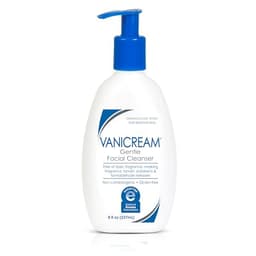
Vanicream Gentle Facial Cleanser
Formulated without fragrance, dyes, lanolin, parabens or formaldehyde releasers. The cleanser for an elimination routine, in a pump bottle.
$9.97 · View on AmazonPrice as of October 8, 2026. #ad How we’re funded
Cetaphil — cleanser
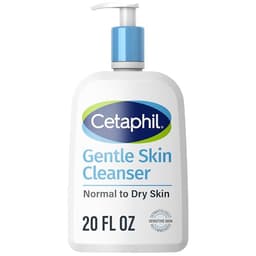
Cetaphil Gentle Skin Cleanser
Glycerin plus mild surfactants in a low-foam lotion, in a bottle several times the size for less money. Can be used with or without water.
Vanicream — moisturizer
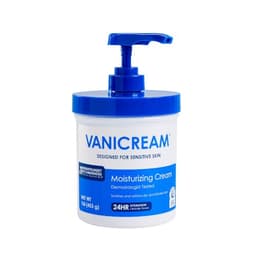
Vanicream Moisturizing Skin Cream
The same exclusion list in a rich cream, in a hygienic pump tub rather than a jar you dip fingers into.
Cetaphil — moisturizer
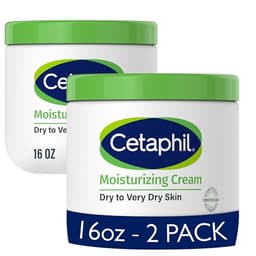
Cetaphil Moisturizing Cream
Glycerin and emollients in a rich, occlusive base for dry-to-very-dry skin, at the lowest price of the four.
$18.91 · View on AmazonPrice as of October 8, 2026. #ad How we’re funded
Cetaphil and Vanicream are the two brands a dermatologist reaches for when the instruction is “stop everything and use something boring.” They occupy almost the same shelf space, make almost the same promise, and cost roughly the same. Which is exactly why the choice between them is confusing: the difference is not in what they contain, but in what each brand is willing to put in writing.
The actual difference: a promise versus a price
Vanicream sells an exclusion list.Both the Gentle Facial Cleanser and the Moisturizing Skin Cream are formulated without fragrance, dyes, lanolin, parabens and formaldehyde releasers — five of the most common culprits in contact dermatitis. That list is not a side note on the packaging; it is the reason the brand exists and the reason it turns up in patch-testing and elimination-routine advice. You are buying a documented absence.
Cetaphil sells gentleness at scale.The Gentle Skin Cleanser is glycerin plus mild surfactants, the Moisturizing Cream is glycerin plus emollients in a rich base, both are fragrance-free, and both have a long track record on sensitive skin. What Cetaphil does not do is commit to the same formal exclusion list — and what it does do is cost less and sell in a bottle you can find in any pharmacy in the country, in sizes that bring the price per ounce down further.
Neither brand brings an active. No retinol, no niacinamide at a stated strength, no acid. If you want those, they belong in a separate step — see how to build a routine for where to slot them in. Both of these brands are the quiet base layer that an active sits on top of.
Cetaphil vs Vanicream at a glance
| Cetaphil | Vanicream | |
|---|---|---|
| The proposition | Mild, cheap, available everywhere | A published list of what is left out |
| Cleanser | Gentle Skin Cleanser — low-foam lotion, glycerin + mild surfactants, usable with or without water | Gentle Facial Cleanser — light gel-lotion, minimal surfactants, pump bottle |
| Moisturizer | Moisturizing Cream — rich, occlusive, glycerin + emollients | Moisturizing Skin Cream — rich, barrier emollients, pump tub |
| Fragrance | Fragrance-free | Fragrance-free, and formally free of dyes and lanolin too |
| Ceramides | Not the lead ingredient | Not in these two products |
| Price band | Budget, and the cheaper of the two | Budget, with a small premium for the exclusion list |
| Best for | Dry, sensitive skin on a budget | The most reactive skin; elimination routines |
Cleanser against cleanser
These two cleansers do the same job in slightly different textures. Cetaphil’s is a low-foam lotion that can be wiped off without water — genuinely useful for skin so irritated that rinsing stings, or for travel. Vanicream’s is a light gel-lotion in a pump, a touch less substantial on the skin, and the one chosen for what it omits rather than what it adds.
Both share the same honest limitation: they are too mild to strip heavy product.Vanicream’s will not take off a day’s worth of sunscreen in one pass, and Cetaphil’s has minimal power against makeup. That is not a defect — it is the direct consequence of using as little surfactant as possible. The fix is not a harsher cleanser but a second step: read how to double cleanse and keep the gentle wash as the second pass, where it belongs.
If your skin is dry rather than reactive and you want the cleanser to leave something behind, a ceramide-led lotion cleanser is the better buy than either of these — which is why neither tops our dry-skin cleanser roundup.
Cream against cream
Both are rich, occlusive creams for dry-to-very-dry skin, and both are correctly described as plain. Cetaphil’s Moisturizing Cream does the occlusion job well at the lowest price of the four products here; the honest cost is that it leans less on barrier-identical ceramides than the CeraVe-style alternatives, and the jar format is less hygienic than a pump.
Vanicream’s Moisturizing Skin Cream answers that second point directly: it ships in a pump tub, which keeps fingers out of the product. It carries the same exclusion list as the cleanser and the same caveat as Cetaphil — no ceramides, no niacinamide, nothing extra — plus an occlusive finish that some people find heavy. For an elimination routine that is a feature. For everyday dry skin that simply wants hydration, it is just a thick cream.
Either one is more effective applied to skin that is still damp, which is the single cheapest upgrade available to a plain moisturizer. Our guide to how much moisturizer to use covers the amount and the timing.
Which should you buy?
Buy Vanicream if…
Your skin reacts to things and you do not yet know what. You have been told to patch test or to strip your routine back. You have a diagnosed contact allergy to lanolin, a fragrance component or a preservative. Or you have simply run out of patience with products marketed as gentle that still break you out — the exclusion list is the most direct way to rule out the usual suspects in one move. It is the brand our sensitive-skin routine and rosacea routine both lean on for the cleanser slot.
Buy Cetaphil if…
You want gentle basics that cost as little as possible and are available in every store. Nothing has ever obviously reacted on your skin. You need a big bottle for a household rather than a careful single-user routine. Or you want a cleanser you can use without water. It is the cheaper, more practical half of this matchup and for most people it is the right call.
Buy neither if…
You are shopping for repair rather than neutrality. Both brands are built to do nothing objectionable, which also means neither is built to do much. If your goal is a barrier that holds water better, a ceramide-led cream is the more direct tool — see our best ceramide moisturizers. If your goal is texture, tone or acne, the work happens in a separate active step and these products are what you put over the top of it.
The honest bottom line
This is one of the lower-stakes decisions in skincare, and it is worth saying so plainly. Both brands are fragrance-free, both are cheap, both will cleanse and moisturize without drama, and nobody has ever damaged their skin by picking the wrong one. Buy Vanicream when the absence of a specific ingredient is the point, and Cetaphil when price and availability are. Then spend the attention you saved on the two steps that actually change outcomes: sunscreen every morning, and one active introduced slowly.
General guidance, not medical advice. Barrier & Balm is written by a skincare enthusiast, not a dermatologist. For a diagnosis, a reaction, or a prescription active like tretinoin, see a qualified professional. Introduce any new active slowly and patch-test first.
Frequently asked questions
Is Vanicream worth the extra money over Cetaphil?
If you have a diagnosed contact allergy, eczema that flares unpredictably, or you are running an elimination routine to find a trigger, yes — you are paying for a published exclusion list, and that list is the product. If your skin is simply dry or a bit sensitive and nothing has ever obviously reacted, no: Cetaphil does the same gentle job for less and is easier to find. Price per ounce also narrows the gap more than the shelf price suggests, since both brands sell large sizes.
Do Cetaphil and Vanicream contain ceramides?
Neither leads on ceramides, and that is the clearest practical difference between these two brands and CeraVe. Cetaphil's cleanser and cream work through glycerin and emollients; Vanicream's work through barrier emollients in a minimal formula. If barrier-identical lipids are what you are shopping for, a ceramide-led product is the more direct route — see our best ceramide moisturizers for the picks that are built around them.
Which is better for eczema-prone skin?
Vanicream, on the strength of what it leaves out: fragrance, dyes, lanolin, parabens and formaldehyde releasers are among the most common contact irritants, and removing all of them is a sensible starting point when skin is flaring for reasons you cannot pin down. Cetaphil is still a reasonable gentle option. For itch specifically, a colloidal-oatmeal formula adds something neither brand does — colloidal oatmeal is an FDA-recognized skin protectant.
Can I mix the two brands?
Yes, and most people effectively do. There is no formulation reason to keep a routine within one brand — brand loyalty in gentle basics is marketing, not chemistry. A Vanicream cleanser with a Cetaphil cream, or either with a ceramide moisturizer, is a perfectly coherent routine. What matters is that each step is fragrance-free and non-stripping, not that the labels match.
Will either one remove makeup or sunscreen?
Not reliably in one pass. Both cleansers are mild by design, and that mildness is the trade: Vanicream's is noted as too gentle to take off heavy sunscreen in a single wash, and Cetaphil's has minimal cleansing power against heavy makeup. If you wear either daily, double cleanse — an oil or balm first to break the product down, then the gentle cleanser to actually wash your face.
Sources
- American Academy of Dermatology — Skin care basics — AAD consumer guidance on cleansing, moisturizing and sun protection (accessed July 17, 2026)
- American Academy of Dermatology — Face washing 101 — AAD guidance on gentle cleansing technique (accessed July 17, 2026)
- Moisturizers — StatPearls (NCBI Bookshelf) — Reference on humectants (hyaluronic acid), occlusives and emollients (accessed July 17, 2026)
- American Academy of Dermatology — Dermatologists' top tips for relieving dry skin — AAD on moisturizing damp skin and choosing a cream for dry skin (accessed July 17, 2026)
Keep reading
CeraVe vs Vanicream
Ceramides versus a minimal exclusion list — the other half of this decision.
Read the comparisonCeraVe vs Cetaphil
The drugstore matchup people search for most, settled on formulas rather than brand reputation.
Read the comparisonBest cleansers for dry skin
Where both brands' cleansers place against the ceramide-led and cream-to-foam alternatives.
See the picksBest moisturizers for dry skin
Both brands' creams ranked alongside CeraVe, La Roche-Posay and First Aid Beauty.
See the picksBest skincare for sensitive skin
A full five-product routine for reactive skin, built around what it leaves out.
See the routineHow to read an ingredient label
What 'free of' claims actually commit a brand to, and where to look for the ones that matter.
Read the guide