Can You Use Retinol Around Your Eyes?
Yes — the eyelid is the thinnest skin on the body, which is the reason for care, not the reason to skip it. The orbital-bone rule, the three-week ramp, and when to stop.
How this is funded: we earn a commission if you buy through our links, at no extra cost to you. It never changes which product we recommend, and we’ll tell you when we’d skip one. Full disclosure.
What to use, by how cautious you need to be
Three ways in: a dedicated eye retinol, a buffered face serum you can take carefully up to the orbital bone, and the ceramide cream that makes either of them tolerable. We have tested none of them; picks come from published formulation facts, and prices are checked daily.
Dedicated eye retinol
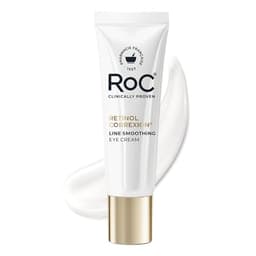
RoC Retinol Correxion Under Eye Cream
Retinol in a 15 ml eye format with panthenol and a mineral complex — formulated for the area, though like most drugstore retinols it does not state its strength.
Buffered, if you are nervous
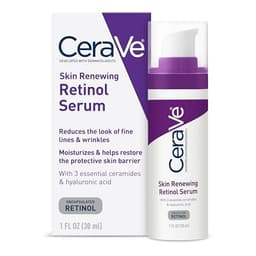
CeraVe Skin Renewing Retinol Serum
Encapsulated retinol with ceramides, niacinamide and hyaluronic acid in the same bottle, so the buffering is built in rather than layered. Fragrance-free.
The buffer itself
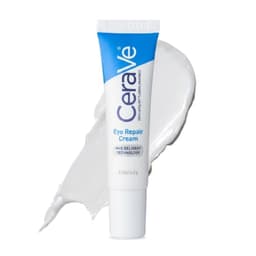
CeraVe Eye Repair Cream
Ceramides, niacinamide and hyaluronic acid with no active to irritate. Apply before or after a retinol to cut the dryness that makes people quit.
Why the eye area is treated as off-limits (and why that is wrong)
Two true facts have combined into a false conclusion. The first is that eyelid skin is the thinnest on the body — a published review of under-eye darkness lists exactly that thinness, along with the visible vasculature beneath it, among the reasons the area looks the way it does. The second is that retinoids cause dryness, flaking and redness while skin adapts. Put those together and “never put retinol near your eyes” sounds sensible.
But the conclusion does not follow, for a straightforward reason: the eye area is also where the signs retinol addresses — fine lines, crepey texture, loss of firmness, pigment — appear first and most visibly. Skipping the one topical class with real evidence for those, in the one place they show up earliest, is a bad trade. The AAD’s own explanation of retinoids and retinol is that these are the anti-aging ingredients with the research behind them; nothing in that record carves out the periorbital area.
What the thinness does change is the dose and the technique. Irritation that would be invisible on a cheek is a week of looking tired here. So the answer is not avoidance; it is a smaller amount, further from the lid, less often, with a buffer.
The orbital-bone rule
This is the single most useful piece of technique on this page. Put a fingertip just below your lower lashes and press gently until you feel bone — the orbital rim. That ridge, and its counterpart under the brow, is where an eye product goes. Not on the soft lid, not along the lash line.
The reason is migration. Anything you apply to the eye area spreads over the next few hours, helped by blinking, body heat and the natural movement of the tissue. Apply at the lash line and some of it ends up in your eye, which is where the watering and the stinging that people blame on retinol itself actually comes from. Apply on the bone and the product migrates inward to cover the area you wanted in the first place — at a dose diluted by the journey.
Amount: a grain of rice for both eyes, patted in with a ring finger rather than dragged. If you can feel a film, it is too much. The eye area is the one place in skincare where using less genuinely works better.
The three-week ramp
Treat the eye area as a separate ramp from your face, even if you are using the same bottle. A schedule that works for most people:
| Stage | Frequency | What to do | What is normal |
|---|---|---|---|
| Week 1 | Twice, non-consecutive nights | Moisturizer first, then a grain of rice on the orbital bone, then moisturizer again | Slight tightness the next morning |
| Week 2 | Twice to three times | Same, dropping the first moisturizer layer if comfortable | Mild dryness, perhaps fine flaking |
| Week 3–4 | Three times | Retinol, then moisturizer | Dryness settling down |
| Month 2 onward | Three to five times, or whatever you tolerate | Hold at the highest frequency that produces no visible irritation | Nothing — if you still flake, go back a stage |
Nightly is not the goal. Three comfortable nights a week, sustained for a year, beats seven nights a week sustained for a fortnight, and the published work on retinoid photoaging measures results over months rather than weeks. The how often to use retinol guide covers the face version of the same logic.
Buffering, and why it does not waste the retinol
Applying a moisturizer before the retinol — or on either side of it, which is the retinol sandwich method— reduces irritation. It does slightly reduce how much retinol reaches the skin, and that is the trade: a somewhat lower effective dose that you can actually keep using. For the eye area, where tolerance is the binding constraint rather than potency, this is almost always the right call for the first month.
The buffer should be boring: a fragrance-free ceramide cream, nothing with its own active. Hyaluronic acid, ceramides and squalane sit in the safe column against everything on our ingredient conflict chart precisely because this is their job.
When to stop
Stop and let the area recover if you get any of these, rather than pushing through:
- Redness that is still there the next evening, as opposed to an hour after application.
- Flaking on the lid itself— that means the product is going somewhere it should not.
- Eyes that water or sting every time, which is migration into the eye rather than a skin reaction.
- New sensitivity to products you previously tolerated, the classic sign of a compromised barrier — see how to repair your skin barrier.
- Swollen or itchy lids, which can be contact dermatitis rather than retinoid irritation and is worth a clinician’s opinion.
Recovery is a week or two of cleanser, moisturizer and sunscreen only. Then restart at half the frequency with a buffer. A pause is not a failure; it is the normal shape of getting a retinoid established on difficult skin.
Three situations where the answer is no
Pregnancy and trying to conceive.The AAD’s pregnancy skin care guidance says not to use retinoids, and it names over-the-counter products containing retinol alongside the prescription ones. That applies to an eye cream exactly as much as a face serum. What to do instead is in pregnancy-safe skincare.
An active eye condition.Blepharitis, eczema on the lids, or any diagnosed inflammatory condition around the eye is a clinician’s territory, and a retinoid on top of it is a bad idea.
Immediately after a procedure. Lash extensions, lash lifts, recent laser or injectables around the eye all come with their own aftercare, and it outranks this page.
If none of those apply, the honest summary is the one at the top: yes, with a grain of rice, on the bone, twice a week to begin with, over a moisturizer. The eye area is not a forbidden zone — it is simply the part of your face with the least margin for a heavy hand. And if retinol turns out not to suit you here at all, peptides are the gentler route with more modest evidence; our peptides explainer sets out what they can reasonably be expected to do.
General guidance, not medical advice. Barrier & Balm is written by a skincare enthusiast, not a dermatologist. For a diagnosis, a reaction, or a prescription active like tretinoin, see a qualified professional. Introduce any new active slowly and patch-test first.
Frequently asked questions
Is retinol safe for the eye area?
For most people, yes, used carefully. The skin around the eye is the thinnest on the body, so it shows irritation sooner and more visibly than a cheek does — but that is an argument for a lower dose and a slower ramp rather than for avoidance. Apply a grain-of-rice amount on the orbital bone, start twice a week, and buffer with a moisturizer if it stings. Retinol is not for use in pregnancy.
Can I use my regular face retinol around my eyes, or do I need an eye-specific one?
Either works. A dedicated eye retinol is usually a lower dose in a more emollient base, which makes it a gentler start. A face retinol applied sparingly to the orbital bone is the cheaper route and perfectly reasonable if you already tolerate it elsewhere — the strength of the product matters far more than whether the box says 'eye'. Avoid the strongest formulas you own for this area.
Will retinol get rid of dark circles?
Only the kinds caused by pigment and by thin, crepey skin — and slowly, over months. A published review of under-eye darkness sorts the causes by anatomic layer, and retinol acts on the skin layer: pigment and texture. If your darkness is a shadow cast by the contour under your eye, which you can check by tilting your chin toward a light, no topical reaches it.
Why do my eyes water or sting when I use retinol?
Almost always because the product is too close to the lash line and has migrated into the eye, or because the dose is too high for skin that has not adapted yet. Move your application point out to the orbital bone, cut back to twice a week, and apply a plain moisturizer first as a buffer. If stinging persists at a low frequency with a buffer, stop — some people simply do not tolerate retinoids here.
How long until I see a difference around my eyes?
Three months is a realistic first checkpoint and six is where the published work on photoaging tends to measure. The eye area often shows the opposite in the first two weeks — some dryness and fine flaking as skin adjusts — which is why so many people quit before the part that works. If nothing has changed at six months of consistent use, the dose is probably too low or the problem is not one retinol addresses.
Can I use retinol under my eyes if I use it on my face too?
Yes, and most people do — it is the same product applied more sparingly. What you should not do is stack two retinoids, a face retinol plus a retinol eye cream on the same night, because they act on the same receptors and you are only multiplying the irritation. Pick one.
What should I avoid combining with an eye retinol?
Exfoliating acids on the same night, benzoyl peroxide at the same time of day, and any second retinoid. The eye area has the least tolerance on your face, so the margin for stacking irritation is smallest here. Our ingredient conflict chart covers which pairs can share a routine.
Sources
- American Academy of Dermatology — Retinoid or retinol? — AAD on the difference between prescription retinoids and OTC retinol (accessed July 17, 2026)
- Human Skin Aging and the Anti-Aging Properties of Retinol (PubMed) — Review of topical retinol's effect on collagen and photoaging (accessed July 17, 2026)
- The use of retinoids in the treatment of photoaging (PubMed) — Clinical-trial evidence for topical retinoids in photoaging (accessed July 17, 2026)
- Infraorbital Dark Circles: A Review of the Pathogenesis, Evaluation and Treatment (PMC) — Vrcek, Ozgur & Nakra, J Cutan Aesthet Surg 2016 — sorts the causes of under-eye darkness by anatomic layer (bone and ligament structure; midface soft tissue, vasculature and fluid; skin pigmentation, thinness and telangiectasia) and recommends therapy customised to the identified cause: topical agents against the pigment and vascular contributions, volume restoration and surgery against the structural ones (accessed October 11, 2026)
- American Academy of Dermatology — Dermatologist-approved pregnancy skin care — AAD: do not use retinoids during pregnancy ("prescription acne treatments like isotretinoin, tretinoin, and tazarotene, along with over-the-counter skin care containing retinol like adapalene"), nor hydroquinone, finasteride, spironolactone, tetracycline-class antibiotics or 5-fluorouracil; use sparingly high-dose salicylic acid, benzoyl peroxide, parabens, phthalates, phenol, triclosan and essential oils (accessed October 11, 2026)
Keep reading
Best eye creams for dark circles
Which under-eye complaints a topical can reach, sorted by cause, with the retinol pick in context.
See the picksRetinol explained
What it does, what the evidence supports, and how it compares with the prescription retinoids.
Read the explainerRetinol strengths
What 0.2%, 0.5% and 1% actually mean, and why most drugstore products publish nothing.
Read the guideThe retinol sandwich method
Moisturizer, retinol, moisturizer — the buffering technique, and what it costs in potency.
Read the guideIngredient conflict chart
What retinol can share a night with, and what belongs in a different routine.
See the chartPregnancy-safe skincare
Why retinol comes out of the routine, and the six-product routine built from what is left.
Read the guide