PanOxyl 4% vs 10%
Same brand, same active, two and a half times the dose — and the published evidence says the extra dose buys irritation rather than results. Which wash belongs on your face, and which on your back.
How this is funded: we earn a commission if you buy through our links, at no extra cost to you. It never changes which product we recommend, and we’ll tell you when we’d skip one. Full disclosure.
The two washes, and the two upgrades
Both PanOxyl washes plus the two products people most often need alongside them. We own no units and have tested nothing; the specs come from each product's own label and listing, and prices are checked daily.
For the face
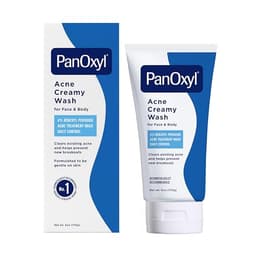
PanOxyl Antimicrobial Acne Creamy Wash (4% Benzoyl Peroxide)
4% benzoyl peroxide in a fragrance-free creamy base with glycerin, sorbitol and propanediol. A sensible starting strength that keeps dryness down, and easy to step up from.
For back and chest
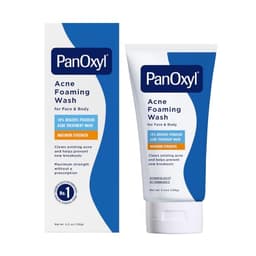
PanOxyl Acne Foaming Wash (10% Benzoyl Peroxide)
Maximum OTC strength at 10%, in a foaming wash. Effective on stubborn body acne where skin is thicker; more than most faces need, and it contains fragrance.
4% with ceramides
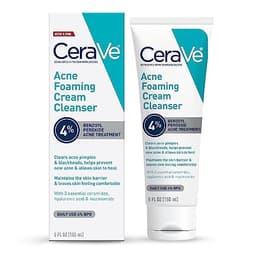
CeraVe Acne Foaming Cream Cleanser (4% Benzoyl Peroxide)
The same 4% benzoyl peroxide with ceramides and hyaluronic acid in the formula — the pick if the PanOxyl 4 still leaves your face tight. Fragrance-free.
If a wash is not enough
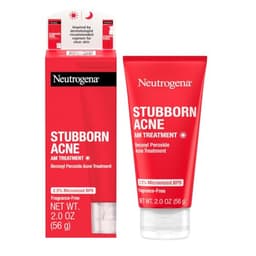
Neutrogena Stubborn Acne AM Treatment (2.5% Benzoyl Peroxide)
A 2.5% leave-on benzoyl peroxide treatment. Contact time, not concentration, is what a wash lacks — this is the right way to add more, rather than buying a stronger wash.
$12.97 · View on AmazonPrice as of October 17, 2026. #ad How we’re funded
The labels, side by side
Benzoyl peroxide at these strengths is regulated as an over-the-counter acne drug, so the percentage has to appear in a Drug Facts panel on the box. Everything in this table is read off that panel or off the product’s own listing — which makes this one of the few comparisons on this site where the key number is not a guess.
| PanOxyl Antimicrobial Acne Creamy Wash | PanOxyl Acne Foaming Wash | |
|---|---|---|
| Stated benzoyl peroxide | 4% | 10% — maximum OTC strength |
| Format | Creamy wash | Foaming wash |
| Base | Three humectants — glycerin, sorbitol, propanediol — plus emollients | No barrier support stated |
| Fragrance | Fragrance-free | Contains fragrance |
| Best area | Face | Back, chest, shoulders |
| Best for | Starting out, or drier and more sensitive acne-prone skin | Stubborn body acne; resilient, very oily skin |
| Size | Not published (6 oz tube) | 156 ml |
| Bleaches fabric | Yes | Yes |
Why the stronger one is not the better one
The instinct that a 10% must work better than a 4% is reasonable and, in this one case, wrong — and we know it is wrong because somebody checked. Mills, Kligman, Pochi and Comite ran three double-blind studies with 153 patients with mild to moderately severe acne, published in the International Journal of Dermatologyin 1986. They compared a 2.5% benzoyl peroxide formulation against its own vehicle and against proprietary 5% and 10% gels. The 2.5% beat its vehicle, and it was “equivalent to the 5% and 10% concentrations in reducing the number of inflammatory lesions (papules and pustules).” On tolerability it won: “Desquamation, erythema, and symptoms of burning with the 2.5% gel were less frequent than with the 10% preparation but equivalent to the 5% gel.”
Two things follow. First, if 2.5% matches 10% on efficacy, then 4% is comfortably in the range where the active is doing its job. Second, the gap between the two PanOxyl washes is almost entirely a gap in irritation. That is why newer benzoyl peroxide products across the market have drifted downward in strength rather than upward — the lower doses deliver comparable results with better tolerability, and tolerability is what determines whether anyone is still using the product in month three.
It is worth being precise about how strong the overall evidence is, too. The Cochrane review of topical benzoyl peroxide concluded that it “may be more effective than placebo or no treatment” on participant-reported improvement — a risk ratio of 1.27 across three trials and 2,234 participants — and rated that evidence low-certainty. It also found that the “risk of treatment discontinuation may be higher with BPO compared with placebo or no treatment,” most often because of redness, itching and burning. Benzoyl peroxide is a genuinely useful active with a real side-effect profile, not a miracle and not a menace.
The part the percentage does not tell you
Comparing these two on the number alone misses the bigger practical difference. The 4% is formulated to be tolerable: a creamy base with glycerin, sorbitol and propanediol holding water against the skin, emollients to soften the rinse, and no fragrance. The 10% is a straightforward foaming wash with fragrance in it.
So the choice is not “mild dose versus strong dose.” It is “lower dose in a cushioned, fragrance-free base” versus “highest OTC dose in a stripping, scented one.” On a face — especially a face that is also using a retinoid, an acid, or both — that stacks the decision heavily toward the 4%. On a back in a hot shower, the foaming format is genuinely easier to use and the fragrance is a non-issue for most people.
If the 4% still leaves your face tight, the next move is not a different percentage, it is a better base: a 4% benzoyl peroxide wash with ceramides and hyaluronic acid in the formula, which is the third pick above. Same active, same dose, more buffering.
How to use either one without wrecking your barrier
Start once a day, at night, on three days of the first week. Lather in your hands rather than scrubbing, leave it on for twenty to thirty seconds, rinse with lukewarm water, and moisturize within a minute while the skin is still damp. Build to daily, and to twice daily only if nothing is tight or flaking. On the body, a minute of contact in the shower is plenty.
An oil-free moisturizer is not optional with either strength, and it does not undo the wash — moisturizers for acne-prone skin ranks the ones chosen for exactly this routine. Daily SPF matters more than usual too; see sunscreen for acne-prone skin. And if you are pairing benzoyl peroxide with other actives, read benzoyl peroxide with retinol and what not to mix with benzoyl peroxide before you combine anything.
Give either wash eight weeks before you judge it. Acne you can see today was set in motion weeks ago, so the first fortnight tells you about your tolerance and nothing about the result. And if eight consistent weeks of a medicated wash have changed nothing, the answer is contact time rather than concentration: a leave-on treatment, which is what published acne guidance is built around. A stronger wash is the one upgrade that reliably does not help.
General guidance, not medical advice. Barrier & Balm is written by a skincare enthusiast, not a dermatologist. For a diagnosis, a reaction, or a prescription active like tretinoin, see a qualified professional. Introduce any new active slowly and patch-test first.
Frequently asked questions
Is PanOxyl 10% better than 4%?
Not for the face. Mills and colleagues compared 2.5%, 5% and 10% benzoyl peroxide across three double-blind studies with 153 patients (International Journal of Dermatology, 1986) and found the 2.5% formulation equivalent to the 5% and 10% at reducing inflammatory lesions, while desquamation, erythema and burning at 2.5% were less frequent than with the 10%. The 10% has a legitimate use on thicker body skin and on resilient oily skin, but it is not a stronger treatment so much as a more irritating one.
What is the difference between PanOxyl 4 and PanOxyl 10 besides the percentage?
The base. The 4% is a creamy wash with three humectants — glycerin, sorbitol and propanediol — plus emollients, and it is fragrance-free. The 10% is a foaming wash that contains fragrance and states no barrier support. So the 4% is the gentler option on two counts, which is why it is the face pick even for people who tolerate benzoyl peroxide well.
Can I use PanOxyl 10 on my face?
You can, and plenty of people with resilient, very oily skin do. Expect dryness, and keep the contact time short — lather, thirty seconds, rinse, moisturize immediately. If your skin flakes, stings or gets red and tight within the first week, that is the formulation telling you to drop to the 4%, not a sign you need to push through.
Which PanOxyl is better for body and back acne?
The 10%. Body skin is thicker and more tolerant than facial skin, body acne tends to be more stubborn, and the foaming format is easier to spread across a back in the shower. Leave it on for a minute before rinsing, and use white towels — benzoyl peroxide bleaches fabric, which the Cochrane review states plainly.
How often should I use a benzoyl peroxide wash?
Start on three days of the first week, once a day, and build from there. Both strengths are drying, and the most common failure is going twice daily from day one, ending up with a stripped, flaking face, and quitting in week two. The Cochrane review found that people on benzoyl peroxide are roughly twice as likely to stop treatment because of side effects — erythema, itching and burning — so ramping slowly is the whole game.
Does PanOxyl bleach towels and pillowcases?
Yes, both strengths, and there is no formulation that avoids it. The Cochrane review notes that in contact with hair, clothing and other fabrics benzoyl peroxide can cause bleaching. Use white towels and a white pillowcase and rinse your hands after applying.
Should I use a benzoyl peroxide wash or a leave-on treatment?
A wash is the gentler way in; a leave-on does more. The limiting factor on any wash is contact time — under a minute, then down the drain — so if eight consistent weeks of a medicated wash have not changed anything, the next step is a leave-on benzoyl peroxide or a retinoid rather than a stronger wash. That is the direction published acne guidance points, and it is also the kinder route for your barrier.
Can I use benzoyl peroxide with a retinoid?
Yes, and the combination is a mainstay of acne treatment — but keep them at opposite ends of the day for the first month, especially if the retinoid is adapalene or a prescription. Doing both at night on freshly washed skin is how people end up too irritated to continue with either.
Sources
- Comparing 2.5%, 5%, and 10% benzoyl peroxide on inflammatory acne vulgaris (PubMed) — Mills, Kligman, Pochi & Comite, Int J Dermatol 1986;25(10):664-7 — three double-blind studies, 153 patients: the 2.5% formulation was "more effective than its vehicle and equivalent to the 5% and 10% concentrations in reducing the number of inflammatory lesions (papules and pustules)", while "desquamation, erythema, and symptoms of burning with the 2.5% gel were less frequent than with the 10% preparation but equivalent to the 5% gel" (accessed October 17, 2026)
- Topical benzoyl peroxide for acne — Cochrane Database of Systematic Reviews (PMC) — Yang, Zhang, Lazic Mosler et al., Cochrane Database Syst Rev 2020 — benzoyl peroxide "may be more effective than placebo or no treatment" on participant-reported improvement (RR 1.27, 95% CI 1.12 to 1.45; 3 trials, 2,234 participants, low-certainty evidence); "risk of treatment discontinuation may be higher with BPO compared with placebo or no treatment" (RR 2.13), most often for erythema, pruritus and skin burning; and "when in contact with hair, clothing, and other fabrics, BPO can cause bleaching" (accessed October 17, 2026)
- American Academy of Dermatology — Acne: Diagnosis and treatment — AAD overview of benzoyl peroxide, retinoids, salicylic and azelaic acid for acne (accessed July 17, 2026)
- Guidelines of care for the management of acne vulgaris (PubMed) — 2024 AAD acne guideline of care (accessed July 17, 2026)
- American Academy of Dermatology — Face washing 101 — AAD guidance on gentle cleansing technique (accessed July 17, 2026)
Keep reading
Best face wash for acne
Both PanOxyl washes in context, with the salicylic acid options sorted by breakout type.
See the picksSalicylic acid vs benzoyl peroxide
Which active for which lesion — the decision that comes before this one.
Read the comparisonBenzoyl peroxide explained
What it does to acne bacteria, what strength to use, and how to live with the bleaching.
Read the guideHow to use benzoyl peroxide
The ramp-up schedule, the layering rules, and what to do when it dries you out.
Read the guideBenzoyl peroxide vs adapalene
The leave-on decision, once the wash alone has stopped being enough.
Read the comparisonBest moisturizers for acne-prone skin
The step that makes either strength survivable. Oil-free, non-comedogenic, ceramide-backed.
See the picks