The seven washes side by side
Acne washes are the one corner of skincare where percentages are not optional. Benzoyl peroxide and salicylic acid above a cosmetic threshold are regulated as over-the-counter acne drugs, so the strength has to appear in a Drug Facts panel on the box. Every figure in this table is read off that panel or off the product’s own listing. One pick deliberately does not state a percentage — and that is a finding, not a gap.
| Wash | Active & stated strength | Breakout type it targets | Barrier support in the formula | Fragrance | Size |
|---|
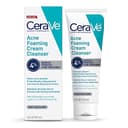
| CeraVe Acne Foaming Cream Cleanser | Benzoyl peroxide 4% | Inflammatory — papules, pustules | Ceramides + hyaluronic acid | Fragrance-free | 150 ml |
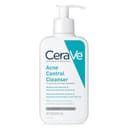
| CeraVe Acne Control Cleanser | Salicylic acid 2% | Comedonal — blackheads, congestion | Ceramides NP/AP/EOP + niacinamide + hyaluronic acid | Fragrance-free | 237 ml |
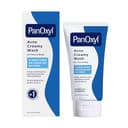
| PanOxyl Antimicrobial Acne Creamy Wash | Benzoyl peroxide 4% | Inflammatory, on drier skin | Three humectants (glycerin, sorbitol, propanediol) + emollients | Fragrance-free | Not published (6 oz tube) |
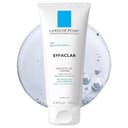
| La Roche-Posay Effaclar Medicated Gel Cleanser | Salicylic acid 2% (+ LHA) | Comedonal, on very oily skin | Glycerin only | Contains fragrance | 200 ml |
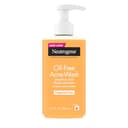
| Neutrogena Oil-Free Acne Wash, Fragrance Free | Salicylic acid 2% | Comedonal, face and body | Glycerin + panthenol, no ceramides | Fragrance-free (this SKU only) | 269 ml |
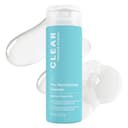
| Paula’s Choice CLEAR Pore Normalizing Cleanser | Salicylic acid 0.5% | Mild congestion on reactive skin | Glycerin + panthenol + arginine | Fragrance-free | 177 ml |
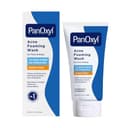
| PanOxyl Acne Foaming Wash | Benzoyl peroxide 10% | Inflammatory, on body and back | None stated | Contains fragrance | 156 ml |
Start here: which kind of acne do you have?
Inflamed, red, sore spots → benzoyl peroxide
Papules (red bumps with no visible head) and pustules (the ones with a white centre) are inflammatory lesions. Benzoyl peroxide is the over-the-counter active with the clearest evidence against them: the Cochrane review of topical benzoyl peroxide found it “may be more effective than placebo or no treatment” on participant-reported improvement across three trials and 2,234 participants, while flagging that the evidence is low-certainty and that people are roughly twice as likely to stop treatment because of side effects. Those side effects are the whole reason a wash is a sensible way to start: contact time is under a minute, so you get the antimicrobial effect with far less of the peeling a leave-on gel produces.
Blackheads, whiteheads, rough congestion → salicylic acid
Comedones are blocked pores, not infected ones. Salicylic acid is a beta hydroxy acid, which the FDA notes is oil-soluble — that is exactly why it is the active for this job: it can get into a sebum-filled pore in a way a water-soluble acid cannot. The honest caveat is the same one as above in reverse: a wash rinses off, so a 2% salicylic cleanser is a daily nudge rather than a treatment. If blackheads are your main complaint, the cleanser is the supporting act and a leave-on BHA is the lead — see how to get rid of blackheads for the full sequence.
Both at once → use them at different times of day
Plenty of skin has inflamed spots on the chin and blackheads on the nose. You can run both actives; you should not stack them in the same wash. The simplest version is a benzoyl peroxide wash at night and the salicylic one in the morning, dropping to alternate days at the first sign of tightness. Salicylic acid vs benzoyl peroxide compares them head to head, and can you use benzoyl peroxide with salicylic acid covers the pairing in detail.
How we judged these
1. Is the strength printed on the box?
Six of these seven state an exact percentage, because at these strengths they are OTC drugs rather than cosmetics. The seventh — CeraVe’s Renewing SA Cleanser, which we have deliberately left off the list — carries salicylic acid mid-ingredient-list with no Drug Facts panel and no number. That is not dishonest, it just means it is sold as an exfoliating cosmetic wash rather than an acne treatment, and it belongs in a page about rough texture rather than this one.
2. Is the stated strength the one you want?
More benzoyl peroxide is not more effective. The classic three-study comparison by Mills and colleagues (International Journal of Dermatology, 1986, 153 patients) found a 2.5% formulation “equivalent to the 5% and 10% concentrations in reducing the number of inflammatory lesions,” while desquamation, redness and burning at 2.5% were “less frequent than with the 10% preparation.” That is why our top pick for the face is a 4% and not the 10%, and why the 10% here is explicitly the back-and-chest choice. The full argument is in PanOxyl 4% vs 10%.
3. Does the formula do anything about the dryness?
This is the criterion that separates the picks. Both actives are drying, and a wash you abandon in week three has treated nothing. Three of these include ceramides or a real humectant system; two are plain surfactant bases that leave every bit of the aftercare to your moisturizer. Neither approach is wrong, but you should know which you are buying — and if it is the plain one, the moisturizer stops being optional.
4. Fragrance, because acne skin is often already irritated
Five of the seven are fragrance-free. Two are not, and both of those are otherwise strong picks — which is a fair trade if your skin tolerates fragrance and a dealbreaker if it does not. Note that Neutrogena’s Oil-Free Acne Wash exists in several versions and only the Fragrance Free SKU is unscented; the original and the Pink Grapefruit are not. Buying the wrong bottle of that one is the single easiest mistake on this page.
What a face wash cannot do for acne
It cannot be your only treatment.Contact time is the limiting factor: under a minute, then down the drain. The 2024 AAD acne guideline framework is built around leave-on topicals — a retinoid, benzoyl peroxide, or both — with washes as adjuncts. If a medicated wash alone has not changed anything in eight weeks, the next step is a leave-on product, not a stronger wash. Our full acne-prone routine lays out that sequence, and benzoyl peroxide vs adapalene covers the leave-on decision.
It cannot out-wash sebum.Washing more often does not reduce oil production, and over-cleansing reliably makes acne-prone skin worse by stripping the barrier. Twice a day is the ceiling for a medicated wash — see how often you should wash your face.
It cannot fix acne scars or post-inflammatory marks. Those are pigment and texture problems left behind after the lesion heals, and no cleanser touches them. How to fade acne scars covers what actually does.
And it will bleach your towels.The Cochrane review puts it plainly: “when in contact with hair, clothing, and other fabrics, BPO can cause bleaching.” This is not a formulation flaw you can shop around — it is what the molecule does. Use white towels and a white pillowcase and stop being surprised by it.
How to use a medicated acne wash without wrecking your barrier
Start once a day, at night, on three days of the first week. Lather in your hands rather than scrubbing at your face, leave it on for twenty to thirty seconds, rinse with lukewarm water, and moisturize within a minute while the skin is still damp. Build to daily, then to twice daily only if nothing is tight or flaking. If you are already using a retinoid, keep the medicated wash and the retinoid on opposite ends of the day for the first month.
The moisturizer is not negotiable with either of these actives, and an oil-free one does not undo the wash — moisturizers for acne-prone skin ranks the ones that pair with benzoyl peroxide and adapalene dryness. Daily SPF matters more than usual too, because both actives leave skin more reactive to sun; our sunscreen picks for acne-prone skin are chosen for exactly that routine.
One last thing worth saying plainly: the most expensive wash on this page is not the best one, and the cheapest is not a compromise. Two of the three cheapest picks state the maximum regulated strength of their active and add ceramides on top. What you are choosing between is breakout type, barrier support and whether you can tolerate fragrance — not price. Buy the one that matches your breakouts, give it eight weeks, and put the money you saved into the leave-on treatment that does the heavier lifting.