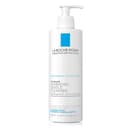
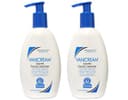
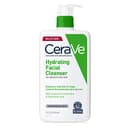
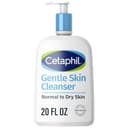
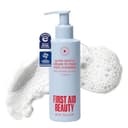
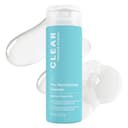
The six picks side by side
No brand in this category publishes a surfactant percentage, so there is no concentration column — any site showing you one has made it up. What can be read off a label is the fragrance status, the format, the size and whether named barrier ingredients appear at all. Those are the columns below.
| Cleanser | Format | What it leaves behind | Fragrance | Removes sunscreen in one pass? | Size |
|---|
| La Roche-Posay Toleriane Hydrating | Creamy, low-lather | Ceramide-3 + niacinamide + glycerin + prebiotic thermal water | Fragrance-free | No — needs a second pass | 400 ml |
| Vanicream Gentle Facial Cleanser | Light gel-lotion, non-foaming | Nothing — by design | Fragrance-free; also no dyes, lanolin, parabens or formaldehyde releasers | No — the mildest here | 474 ml (two-pack) |
| CeraVe Hydrating Facial Cleanser | Lotion, non-foaming | Three ceramides + hyaluronic acid + niacinamide | Fragrance-free | Not reliably | 355 ml |
| Cetaphil Gentle Skin Cleanser | Low-foam lotion | Glycerin; fewer ceramides than CeraVe | Fragrance-free | Not reliably | 591 ml |
| First Aid Beauty Ultra Gentle Cream-to-Foam | Cream that lathers to a soft foam | Colloidal oatmeal + glycerin | Fragrance-free | Mostly, thanks to the light lather | 177 ml |
| Paula’s Choice CLEAR Pore Normalizing | Lightweight gel | Glycerin + panthenol + arginine; 0.5% salicylic acid rinses off | Fragrance-free and dye-free | Yes | 177 ml |
How we judged these
1. Fragrance — and “unscented” is not the same claim
Fragrance is a leading cause of cosmetic contact allergy and it does nothing for your skin, so fragrance-free is the only sensible default here. All six of these picks are fragrance-free, which is why the list is six and not twelve. The trap is the other word on the shelf: the FDA points out that “even some products labeled ‘unscented’ may contain fragrance ingredients,” because a manufacturer may add just enough to mask an unpleasant base odor without giving the product a noticeable scent. The AAD gives the same advice for eczema-prone skin in blunter terms: choose products that say “fragrance-free,” and avoid ones labeled “unscented,” which can contain covered-up fragrance. Our fragrance-free vs unscented comparison unpacks the labeling rules behind that.
2. How hard is the surfactant working?
Foam is a marketing cue, not a cleaning requirement. A high-foam gel generally means a stronger surfactant system, and strong surfactants remove the barrier lipids along with the sebum — which is exactly the feeling people describe as “squeaky clean.” Four of these six are deliberately low-foam or non-foaming; one lathers lightly by design, and one is a true gel for skin that is sensitive andcongested. If your face feels tight within two minutes of rinsing, your cleanser is too strong, full stop — that is the single most useful self-test in skincare and it costs nothing.
3. Does anything barrier-supporting survive the rinse?
Most of a cleanser goes down the drain, but not all of it: ceramides, niacinamide, glycerin and colloidal oatmeal can deposit on the skin surface as you rinse. Three of these six name such ingredients, and our top pick names three of them. One pick names nothing at all, and that is its entire argument — for genuinely allergy-prone skin, the shortest possible ingredient list is the feature, because every ingredient is a candidate suspect in an elimination routine. If you are trying to work out what your skin objects to, how to patch test is the method.
4. Will it actually take off sunscreen?
The criterion the gentle-cleanser category tends to skip. A water-resistant mineral SPF is designed not to rinse away, and the mildest cleansers here will not shift it in one pass — which leaves filters and oil sitting on your face overnight. That is not a reason to buy a harsher wash; it is a reason to cleanse twice in the evening with the same gentle product, or to use an oil or micellar step first. See how to double cleanse and cleanser vs micellar water.
How to choose between these six
If your skin reacts and you do not know to what
Start with the shortest ingredient list, not the most sophisticated formula. The Vanicream is formulated without fragrance, dyes, lanolin, parabens and formaldehyde releasers, which makes it the sensible base for an elimination routine: wash with it for two weeks, change nothing else, and see where you are. Its honest con is on the card — it is so mild it will not remove heavy sunscreen in one pass, and Amazon now stocks it only as a two-pack, so you pay for two bottles up front.
If your skin is sensitive and dry
Then you want a cleanser that gives something back, and that is the case for the Toleriane: ceramide-3, niacinamide and glycerin in a creamy low-lather base that leaves skin comfortable rather than clean-feeling. The con is the flip side of the same formula — the finish can read as a slight film if you like a squeaky rinse. The cheaper near-equivalent is the CeraVe Hydrating lotion cleanser, which also leaves ceramides behind for about a third of the cost per millilitre.
If your skin is sensitive and itchy
Colloidal oatmeal is the differentiator, and it is not a marketing botanical — it is an FDA-recognized skin protectant. The cream-to-foam pick here is the one to buy if your dryness comes with itch or an eczema history, and the format is a reasonable bridge if a true non-foaming cream feels like it has not cleaned anything. Its con is the prestige price for 177 ml. For the full routine around that, see skincare for eczema-prone skin.
If your skin is sensitive and you still break out
This is the common case the “gentle cleanser” aisle serves badly. The 0.5% salicylic acid pick exists for it: a deliberately low acid load, because the brand’s own reasoning is that a cleanser’s contact time is short, so there is no point spending your skin’s tolerance on the step that rinses off. You save it for the leave-on treatment instead. The cons are real — roughly triple the price of the 2% drugstore washes, for a quarter of the acid, and sodium laureth sulfate sits high in the ingredient list. If your acne is the louder problem, our acne face-wash picks sort that shelf by breakout type.
If you are buying for a whole household
Buy the Cetaphil. It is fragrance-free, genuinely mild, comes in a 591 ml bottle and costs less per wash than anything else here. It has fewer barrier ceramides than the CeraVe, which is the only reason it is not higher on the page — and CeraVe vs Cetaphil is a closer call than the internet suggests. Cetaphil vs Vanicream covers the other coin-flip in this group.
What we left out, and why
Anything with fragrance. There are good cleansers with fragrance in them. None of them belongs on a page for skin that reacts, and including one to pad the list to eight picks would be dishonest.
Foaming gel cleansers. Legitimate products, wrong skin type. If your skin is oily andsensitive, the honest answer is usually a low-foam cleanser plus a gel moisturizer rather than a stripping wash plus a rich cream — foaming vs cream cleanser explains the trade.
Cleansers marketed as “calming” without naming an ingredient. Soothing is a result, not an ingredient. Colloidal oatmeal, panthenol, niacinamide and madecassoside are ingredients; a product earns a place here by containing one, not by printing the word on the carton.
Cleansing balms and oils. Often excellent for sensitive skin and a genuinely good first step in a double cleanse, but none is in our product registry, and we do not invent entries to fill a slot.
How to wash sensitive skin
Twice a day is the ceiling and once a day is often enough — a rinse with lukewarm water in the morning and a proper cleanse at night suits a lot of reactive skin. Use lukewarm rather than hot water, apply with your fingertips rather than a cloth or brush, keep the whole thing under about thirty seconds, pat rather than rub dry, and get moisturizer on within a minute while the skin is still damp. The AAD’s face-washing guidance is roughly that, minus the marketing.
If your skin is currently angry, strip the routine back before you shop. One gentle cleanser, one moisturizer, one sunscreen, nothing else, for two weeks — then add one product at a time. How to calm irritated skin is the full version of that reset, and the sensitive-skin routine is what to rebuild toward. For the step after this one, moisturizers for sensitive skin applies the same criteria to the cream.
And the plain version of the advice: the cheapest cleanser on this page is not a compromise and the most expensive is not a treatment. All six do the same physical job with mild surfactants and no fragrance. What you are choosing between is how much the formula gives back, how short the ingredient list is, and whether you need it to shift sunscreen. Buy the one that matches that, and spend the difference on sunscreen you will actually wear.