Barrier & Balm

Best Sunscreen Under $25

The sunscreen you ration is the sunscreen that fails. Six broad-spectrum picks under $25 — mineral and chemical, tinted and clear — ranked on stated filters and cost per full application.

By Stephen V.Last updated How we pick

The short answer

Top pick under $25

For everyday face and neck use. Fragrance-free broad-spectrum SPF 60, cheap enough that you will not ration it.

Budget pick

The cheapest per application here: a stated 10% zinc and 8% titanium, fragrance-free, in a 148 ml face-and-body tube.

Prices live from the retailer as of November 18, 2026. SPF is regulated as an over-the-counter drug in the US, so every US pick here states its filters on a Drug Facts panel.

Buy Neutrogena Invisible Daily Defense SPF 60 if you want the best everyday face sunscreen under $25: fragrance-free, broad-spectrum, and cheap enough that applying a proper quarter-teaspoon twice a day does not feel like spending money. The budget pick is Blue Lizard Sensitive Mineral SPF 50, which works out cheapest per application of anything here and states both its mineral filters on the label. If a white cast is what has stopped you before, the answer under $25 is Black Girl Sunscreen SPF 30 or the three-shade Australian Gold tinted mineral.

Sunscreen is the step where the price argument is strongest, and it is not about value for money in the usual sense. It is about dose. A sunscreen only delivers the SPF on its label at about a quarter-teaspoon for the face, and most people apply a quarter to a half of that. Under-application is the single most common reason a high SPF underperforms in real life — and the most common reason people under-apply is that the tube was expensive and small. A $46 prestige sunscreen used sparingly protects you less than a $13 one used properly. That is the entire case for this page.

So the ranking below weighs three things: whether the filters and their percentages are stated, what the sunscreen looks like on your skin — because a cast you hate is a sunscreen you skip — and the cost of a full, correct application rather than the number on the shelf edge. Every price is live from the retailer and stamped with the date it was read. We own no units and make no testing claims; the filter percentages below are read off the FDA Drug Facts panel, which US sunscreens are legally required to publish.

How this is funded: we earn a commission if you buy through our links, at no extra cost to you. It never changes which product we recommend, and we’ll tell you when we’d skip one. Full disclosure.

Quick picks

Ranked on formulation, stated concentration and buyer fit. Select a row to jump to the full write-up. We have not tested these products — here is exactly what we do instead.

#ProductBest forPrice
1
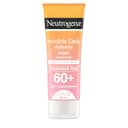
Neutrogena Invisible Daily Defense SPF 60

Neutrogena Invisible Daily Defense SPF 60

The budget high-SPF pick: fragrance-free broad-spectrum SPF 60 with antioxidants at a drugstore price. Nothing fancy, and that's the appeal for a product you should use by the half-teaspoon.

Best overall under $25
$18.99 · View on Amazon

$19.995% off

Price as of November 18, 2026. #ad How we’re funded

2
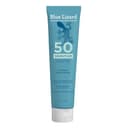
Blue Lizard Sensitive Mineral Sunscreen SPF 50

Blue Lizard Sensitive Mineral Sunscreen SPF 50

A no-frills 100% mineral SPF 50 for genuinely reactive skin, in a big face-and-body tube. Fragrance-free, paraben-free and free of the chemical filters that sting sensitive eyes — the honest trade is a heavier feel and some whitening.

Budget pick, best per application
$13.46 · View on Amazon

$15.9916% off

Price as of November 18, 2026. #ad How we’re funded

3
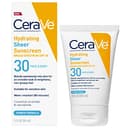
CeraVe Hydrating Mineral Sunscreen SPF 30

CeraVe Hydrating Mineral Sunscreen SPF 30

A budget mineral-based SPF 30 with ceramides for people who want a physical filter without the prestige price. A little cast, but a genuinely gentle, barrier-friendly option.

Best mineral for sensitive skin
$13.97 · View on Amazon

$17.9922% off

Price as of November 18, 2026. #ad How we’re funded

4
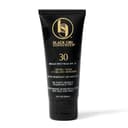
Black Girl Sunscreen Broad Spectrum SPF 30

Black Girl Sunscreen Broad Spectrum SPF 30

Built specifically to disappear on deeper skin tones, which most mineral sunscreens can't do. A moisturizing chemical SPF 30 with no cast — the answer to the single most common sunscreen complaint.

Best for deeper skin tones
$9.99 · View on Amazon

Price as of November 18, 2026. #ad How we’re funded

5
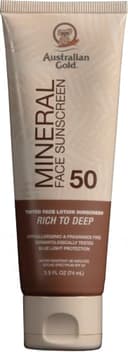
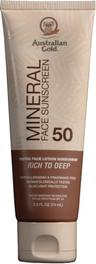
Australian Gold Mineral SPF 50 Tinted Face

Australian Gold Mineral SPF 50 Tinted Face

The rare tinted mineral that comes in an actual shade range — Fair to Light, Medium to Tan and Rich to Deep — so deeper skin tones get a real match instead of a one-size universal tint. A 100% mineral SPF 50 at a drugstore-adjacent price.

Best tinted, with a real shade range
$18.99 · View on Amazon

Price as of November 18, 2026. #ad How we’re funded

6
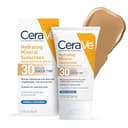
CeraVe Hydrating Mineral Sunscreen Sheer Tint SPF 30

CeraVe Hydrating Mineral Sunscreen Sheer Tint SPF 30

The only tinted mineral here that is also a credible barrier moisturizer: three ceramides, niacinamide, hyaluronic acid and cholesterol sit under a 10% zinc / 5.5% titanium filter pair, at a drugstore price. If your skin is dry, reactive or recovering from an active, this is the tinted SPF that gives something back.

Best for dry, barrier-compromised skin
$13.97 · View on Amazon

$15.9913% off

Price as of November 18, 2026. #ad How we’re funded

The picks in full

#1Best overall under $25

Neutrogena Invisible Daily Defense SPF 60

The budget high-SPF pick: fragrance-free broad-spectrum SPF 60 with antioxidants at a drugstore price. Nothing fancy, and that's the appeal for a product you should use by the half-teaspoon.

Strengths

  • Fragrance-free broad-spectrum SPF 60
  • Antioxidant complex included
  • Cheap enough to apply generously and reapply

Trade-offs

  • Slightly heavier finish than prestige options
  • Can pill under some makeup
Key activeChemical UV filters (SPF 60)
Stated concentrationSPF 60
FormatLotion
Fragrance-freeYes
Best forNormal, Combination

Formulation note. Fragrance-free broad-spectrum SPF 60 + antioxidants. Being cheap is a feature: the biggest sunscreen mistake is under-applying, and price is why people ration it.

Ingredients and claims read from the product listing, on July 17, 2026. “Not published” means the brand does not state that figure.

#2Budget pick, best per application

Blue Lizard Sensitive Mineral Sunscreen SPF 50

A no-frills 100% mineral SPF 50 for genuinely reactive skin, in a big face-and-body tube. Fragrance-free, paraben-free and free of the chemical filters that sting sensitive eyes — the honest trade is a heavier feel and some whitening.

Strengths

  • Stated 10% zinc oxide + 8% titanium dioxide — 100% mineral and fragrance-free
  • Large 5 fl oz tube encourages the generous amount SPF actually needs
  • No oxybenzone or octinoxate, with aloe and vitamin E in the base

Trade-offs

  • Leaves a white cast and feels heavier than a chemical sunscreen
  • Thick texture needs working in, especially on deeper skin tones
Key activeZinc oxide + titanium dioxide (SPF 50)
Stated concentrationSPF 50
FormatMineral lotion
Fragrance-freeYes
Best forSensitive, Reactive, Face and body

Formulation note. 10% zinc oxide + 8% titanium dioxide, 100% mineral, fragrance-free and paraben-free, water resistant up to 40 minutes. Chosen for what it leaves out — no chemical filters, no fragrance — which is why it suits the most reactive skin; the cast is the honest cost.

Ingredients and claims read from the product listing, on August 8, 2026. “Not published” means the brand does not state that figure.

#3Best mineral for sensitive skin

CeraVe Hydrating Mineral Sunscreen SPF 30

A budget mineral-based SPF 30 with ceramides for people who want a physical filter without the prestige price. A little cast, but a genuinely gentle, barrier-friendly option.

Strengths

  • Mineral filters + ceramides + hyaluronic acid
  • Fragrance-free and gentle
  • Low price

Trade-offs

  • SPF 30 rather than 50
  • Mineral cast on deeper tones
Key activeTitanium dioxide + zinc oxide (SPF 30)
Stated concentrationSPF 30
FormatSheer lotion
Fragrance-freeYes
Best forSensitive, Dry, Normal

Formulation note. Mineral filters + 3 ceramides + hyaluronic acid at SPF 30. The ceramides make it the gentle-budget mineral pick; the cast and SPF 30 are the trade-offs.

Ingredients and claims read from the product listing, on July 17, 2026. “Not published” means the brand does not state that figure.

#4Best for deeper skin tones

Black Girl Sunscreen Broad Spectrum SPF 30

Built specifically to disappear on deeper skin tones, which most mineral sunscreens can't do. A moisturizing chemical SPF 30 with no cast — the answer to the single most common sunscreen complaint.

Strengths

  • Formulated to leave no white cast on melanin-rich skin
  • Moisturizing, with jojoba and avocado oils
  • Inexpensive

Trade-offs

  • SPF 30, not 50 — reapply diligently
  • Emollient finish is a touch dewy for very oily skin
Key activeChemical UV filters (SPF 30)
Stated concentrationSPF 30
FormatMoisturizing lotion
Fragrance-freeNo
Best forMedium-to-deep tones, Normal, Dry

Formulation note. Broad-spectrum chemical SPF 30 designed to rub in clear on deeper skin tones. It solves the cast problem mineral filters create — the practical reason it exists.

Ingredients and claims read from the product listing, on July 17, 2026. “Not published” means the brand does not state that figure.

#5Best tinted, with a real shade range

Australian Gold Mineral SPF 50 Tinted Face

The rare tinted mineral that comes in an actual shade range — Fair to Light, Medium to Tan and Rich to Deep — so deeper skin tones get a real match instead of a one-size universal tint. A 100% mineral SPF 50 at a drugstore-adjacent price.

Strengths

  • Three shades (Fair to Light, Medium to Tan, Rich to Deep) for a genuine match on deeper tones
  • Stated 4% zinc oxide + 4% titanium dioxide — 100% mineral and fragrance-free
  • Non-greasy tinted lotion at a mid-range price

Trade-offs

  • You have to pick the right shade — the wrong one reads as a tint mismatch
  • Lower total mineral load than the SPF 50 heavyweights, so apply and reapply diligently
Key activeZinc oxide + titanium dioxide (SPF 50, tinted)
Stated concentrationSPF 50
FormatTinted lotion
Fragrance-freeYes
Best forMedium-to-deep tones, Normal, Sensitive

Formulation note. 4% zinc oxide + 4% titanium dioxide with a tint, 100% mineral and fragrance-free, broad spectrum and water resistant. The three-shade range is the differentiator — it's a tinted mineral built for the deeper tones a single universal tint can't cover.

Ingredients and claims read from the product listing, on September 29, 2026. “Not published” means the brand does not state that figure.

#6Best for dry, barrier-compromised skin

CeraVe Hydrating Mineral Sunscreen Sheer Tint SPF 30

The only tinted mineral here that is also a credible barrier moisturizer: three ceramides, niacinamide, hyaluronic acid and cholesterol sit under a 10% zinc / 5.5% titanium filter pair, at a drugstore price. If your skin is dry, reactive or recovering from an active, this is the tinted SPF that gives something back.

Strengths

  • Stated 10% zinc oxide + 5.5% titanium dioxide — 100% mineral, and the highest zinc load of the tinted picks here
  • Ceramides NP, AP and EOP plus niacinamide, sodium hyaluronate and cholesterol are in the formula, not just the marketing
  • Fragrance-free and the cheapest tinted mineral of the four

Trade-offs

  • SPF 30, the lowest number here — fine by the label, but less headroom when you under-apply
  • A single sheer tint per shade, so matching is coarser than a foundation
  • The emollient base is the point for dry skin and a drawback on oily skin
Key activeZinc oxide + titanium dioxide (SPF 30, tinted)
Stated concentrationSPF 30
FormatTinted lotion
Fragrance-freeYes
Best forDry, Sensitive, Normal

Formulation note. Actives per the FDA OTC label: titanium dioxide 5.5% and zinc oxide 10%. The inactive list carries ceramide NP, ceramide AP, ceramide EOP, niacinamide, sodium hyaluronate, cholesterol and phytosphingosine; no fragrance or parfum appears on the label. It is the one tinted mineral in this set whose base would stand up as a moisturizer on its own.

Ingredients and claims read from the product listing, on October 7, 2026. “Not published” means the brand does not state that figure.

What $25 actually buys

Every price below is read live from the retailer, not typed in by us. All 6 sat under $25 as of November 18, 2026. Cost per ml is calculated from that price and the size printed on the listing — it is the number that decides which of these is actually cheap, and it does not always agree with the one on the shelf edge.

ProductSizeCost per mlPrice
90 ml$0.111
$9.99 · View on Amazon

Price as of November 18, 2026. #ad How we’re funded

148 ml$0.091
$13.46 · View on Amazon

$15.9916% off

Price as of November 18, 2026. #ad How we’re funded

75 ml$0.186
$13.97 · View on Amazon

$17.9922% off

Price as of November 18, 2026. #ad How we’re funded

50 ml$0.279
$13.97 · View on Amazon

$15.9913% off

Price as of November 18, 2026. #ad How we’re funded

88 ml$0.216
$18.99 · View on Amazon

$19.995% off

Price as of November 18, 2026. #ad How we’re funded

74 ml$0.257
$18.99 · View on Amazon

Price as of November 18, 2026. #ad How we’re funded

Prices as of November 18, 2026, refreshed daily. A row showing “Check price on Amazon” is one our feed has no current offer for — we would rather show you nothing than a number we cannot stand behind.

Why the cheap sunscreen is often the better sunscreen

The dose problem, in numbers

The SPF figure on a bottle is measured at a standardised application density. Apply less than that and you do not get a proportionally lower SPF — you get a disproportionately lower one. For a face and neck that works out at roughly a quarter to a third of a teaspoon, or the two-finger rule: a line of sunscreen along the length of your index and middle fingers. Almost nobody does this, and the reason is rarely ignorance. It is that the tube is small and cost more than lunch.

Run the arithmetic the table above runs. A 148 ml tube at $13 gives you around nine cents per millilitre; a 50 ml prestige tube at $46 gives you ninety. At a correct daily dose that is the difference between a sunscreen habit that costs a few dollars a month and one that costs thirty — and the second one is the one people start rationing in week three. Our how much sunscreen to apply guide has the full measurement, and reapplying over makeup covers the part of the day everyone skips.

What a sunscreen under $25 does not skimp on

The filters. In the US, sunscreen is regulated as an over-the-counter drug, not a cosmetic, which means every product here carries a Drug Facts panel naming its actives and their percentages. A $13 mineral lotion stating 10% zinc oxide and 8% titanium dioxide is giving you more disclosure than almost any serum on this site, and the same regulatory framework applies to it as to the $50 one. Broad spectrum means the same thing on both labels; so does water resistance, and so does the SPF number.

That is worth holding onto, because it is unusual. On almost every other shelf we cover, paying more buys better disclosure. On this one, the disclosure is mandatory and the price buys cosmetic elegance.

What it does skimp on: finish

Here the cap costs you something real. Prestige sunscreens are expensive largely because making a high mineral load disappear on skin is genuinely hard chemistry, and the cheaper mineral lotions on this page do leave a cast — most visibly on medium and deep skin tones. Two picks here exist specifically to solve that: Black Girl Sunscreen, a chemical SPF 30 formulated to rub in clear on melanin-rich skin, and Australian Gold’s tinted mineral, which comes in three actual shades rather than one universal tint. If cast is your complaint, start with those two rather than with the plain mineral lotions, and read best sunscreen for dark skin tones and how to avoid a white cast.

Mineral or chemical at this price

Neither category is universally better and the choice is about your skin rather than about safety. Mineral filters— zinc oxide and titanium dioxide — sit on the surface, start working immediately, and are the usual recommendation for reactive, rosacea-prone and post-procedure skin because they are far less likely to sting. The cost is cast and a heavier feel. Chemical filtersabsorb into the top layer, are cosmetically lighter and cast-free, and a minority of sensitive skins react to one or more of them. Three picks here are 100% mineral and two are chemical, which is deliberate — the best sunscreen is the one whose texture you will tolerate twice a day. Our mineral vs chemical comparison goes through the evidence on both.

One thing worth knowing about the mineral picks: the stated zinc percentages vary a great deal. Blue Lizard states 10% zinc plus 8% titanium; CeraVe’s Sheer Tint states 10% zinc plus 5.5% titanium; Australian Gold states 4% and 4% with a tint doing some of the work. Those are all legitimate SPF-tested products, but the lower total mineral load is a reason to apply and reapply more diligently rather than less.

SPF 30 or SPF 50 under $25?

Both are on this page, and the difference between them is smaller than the marketing suggests but not nothing: SPF 30 filters about 97% of UVB at the tested dose and SPF 50 about 98%. The practical argument for the higher number is headroom — since almost everyone under-applies, a higher label gives you more margin when you inevitably use less than the tested amount. The practical argument for SPF 30 is that two picks here at that number solve problems the SPF 50s do not: the cast problem, and the dry-skin problem. Daily SPF 30 you actually wear beats SPF 50 in a drawer. See SPF 30 vs SPF 50 for the full arithmetic and how to choose a sunscreen for the rest of the decision.

A last note on what sits above this cap, so you can judge it for yourself: the registry’s premium sunscreens buy you a near-invisible high-zinc finish, a niacinamide-containing base aimed at acne-prone skin, and dermatologist-channel formulations. Those are real upgrades in wear, and our best face sunscreens page ranks them on their own terms. They are not better at filtering UV than the labeled SPF 60 on this page.
Frequently asked questions

Is cheap sunscreen as effective as expensive sunscreen?

At the same labeled SPF and the same application density, yes. Sunscreen is regulated as an over-the-counter drug in the US, so the SPF number, the broad-spectrum claim and the water-resistance claim all mean the same thing on a $13 tube as on a $46 one, and both must state their filters on a Drug Facts panel. What more money buys is cosmetic elegance — a lighter feel and less cast — not more protection.

How much sunscreen should I use on my face?

About a quarter to a third of a teaspoon for the face alone, or the two-finger rule: a line along the length of your index and middle fingers. Most people apply a quarter to a half of that, which is the single most common reason a high SPF underperforms. This is also the practical reason a cheaper, larger tube protects better than an expensive small one you ration.

Is SPF 30 enough, or do I need SPF 50?

SPF 30 filters roughly 97% of UVB at the tested dose and SPF 50 roughly 98%, so the gap is small in theory. In practice a higher number gives you headroom for the fact that almost everyone under-applies. Either is fine if you use enough and reapply; the sunscreen you will actually wear daily beats the higher number you skip.

Which sunscreen under $25 does not leave a white cast?

Black Girl Sunscreen's chemical SPF 30 is formulated specifically to rub in clear on medium and deep skin tones, and Australian Gold's tinted mineral comes in three real shades rather than a single universal tint. The plain mineral lotions on this page do leave some cast — that is the honest cost of zinc oxide at a drugstore price.

Is mineral sunscreen better than chemical?

Neither is universally better. Mineral filters sit on the surface, work immediately and are the usual choice for reactive, rosacea-prone or post-procedure skin. Chemical filters are lighter and cast-free but a minority of sensitive skins react to them. Both categories are represented under $25, so the choice costs you nothing either way.

Does sunscreen expire?

Yes, and unlike most cosmetics it is legally required to carry an expiration date, because it is regulated as a drug. That is a reason not to stockpile it in a sale and a reason to use a big tube generously rather than making a small one last a year. Heat also degrades it, so a tube left in a car is not a tube to rely on.

Can I use a moisturizer with SPF instead?

Only if you apply it at sunscreen quantities, which is far more than most people use of a moisturizer. A combined product is better than no sunscreen and is a genuinely good answer for people who keep skipping the step, but if you are going to use a pea-sized amount, use a dedicated sunscreen on top instead.

Sources

Keep reading